The Problem Isn’t Staging. It’s Lying.
On staged travel photography, cultural misrepresentation, and the responsibility we carry as photographers
This is a topic that matters, and it should matter to you too. Before I go any further, I want to be clear about something. I don’t enjoy calling photographers out by name because the immediate reaction is almost always the same. People assume jealousy, ego, or some kind of personal agenda. That’s not what this is. This is about ethics, and more importantly, it’s about trust. If we lose that, everything we do as photographers starts to fall apart.
We’ve been here before. If you’ve followed photography long enough, you’ll remember what happened with Steve McCurry. What surprised me at the time wasn’t even the scandal itself, it was how many people rushed to defend it. Most professional photographers understood the issue immediately. You don’t stage travel or documentary images and present them as reality. That crosses a very clear line. McCurry didn’t just stage scenes, he also cloned elements out of his images, removing people and objects to create a more perfect composition. At that point, you’re no longer documenting anything, you’re manufacturing it. What made it worse was how he operated in that gray zone, benefiting from the credibility of organizations like National Geographic while producing work that often resembled commercial productions. As an amateur, it’s easy to admire the perfection, the color, the composition. As a professional, you start to recognize the direction, the control, the manipulation. You stand here, you wear this, move again, hold that. It stops being observation and becomes production. And when it later came out that some of his “candid” images involved hired models and staged props, it confirmed what many of us already suspected.
I’ve written enough about that situation, but the reason I’m bringing it up again is because it set a precedent. The industry let it slide. There were some voices pushing back, but for the most part, people stayed quiet. And now we’re seeing the same behavior becoming more common, especially in travel and so-called humanitarian photography.
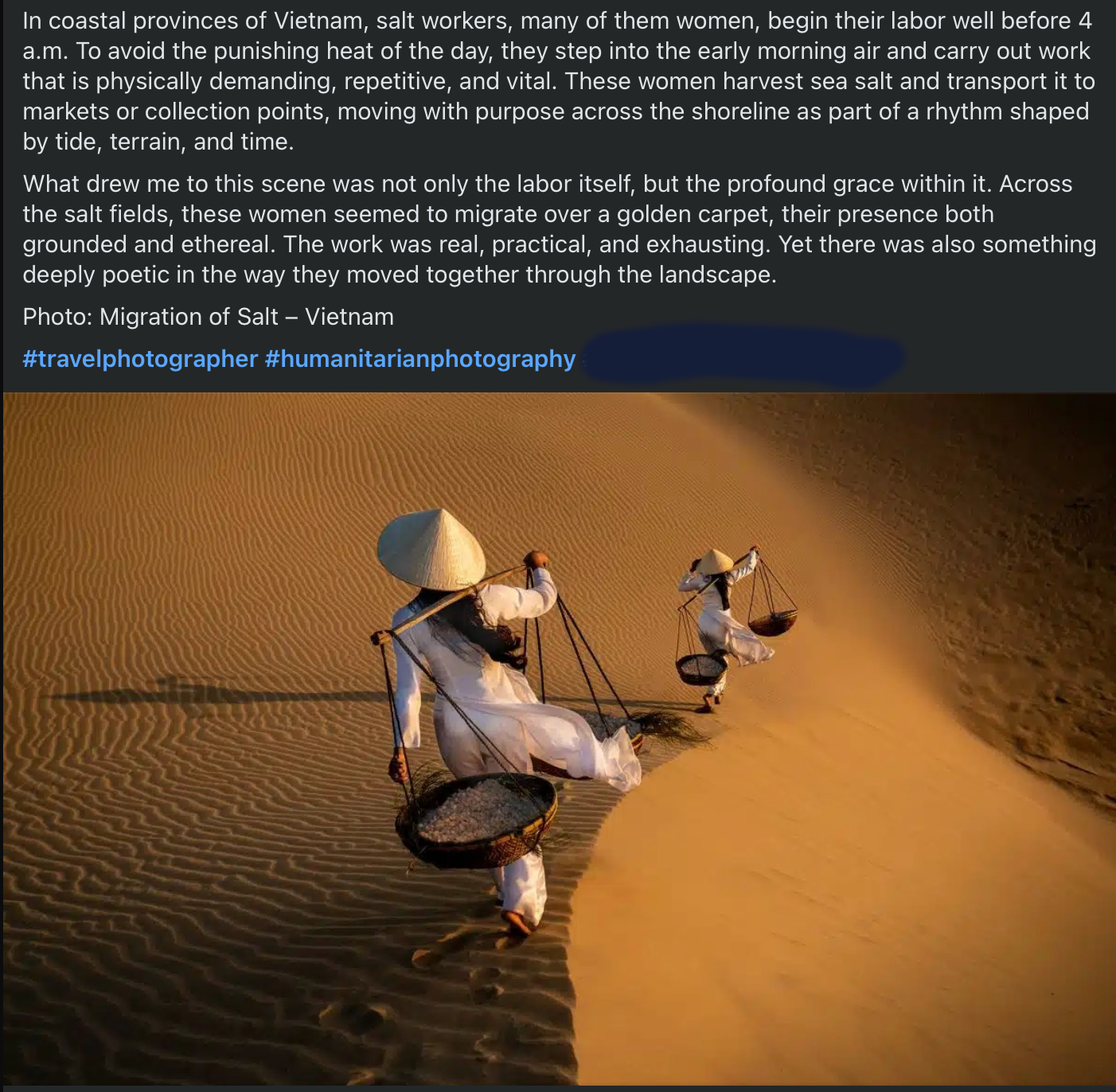
A week ago, I came across a sponsored post on Facebook by an American photographer, decided to leave her website and name off here, featuring a beautifully composed image from Vietnam. That immediately got my attention. I’ve spent over 20 years working in this country, covered it from north to south, and shot over 100 assignments for The New York Times, so I know what I’m looking at.
And I think it’s important to explain my motivation here, because it’s not just about pointing out what’s wrong. It’s twofold. First, I believe strongly in upholding trust as photographers. That’s the foundation of everything we do. Second, I feel a responsibility to defend Vietnamese culture from being misrepresented, especially by people like me who are not from here. Even after 20 years living and working in Vietnam, I have to constantly keep myself in check. I will never be Vietnamese, and that matters. When foreign photographers create work here that reaches a global audience, we carry an added responsibility to represent things accurately. We owe that to the people whose lives and culture we are documenting, whether that’s in Vietnam or anywhere else. And as an educator, I also believe it’s important to have these uncomfortable conversations, even if they’re not popular.
The image showed two women in pristine white áo dài (traditional Vietnamese dress) wearing conical hats, walking through sand dunes while carrying traditional shoulder poles with baskets. Visually, it’s striking, no question. But almost immediately, something felt off. I’ve seen this pattern too many times before, images that appear carefully constructed to feel authentic, often performing well online because they check all the boxes of what people think a place like Vietnam should look like.
Normally, I would have rolled my eyes and moved on. But this time, there was a long caption, so I decided to read it. The caption described salt workers in Vietnam, women waking before 4 a.m., enduring physically demanding labor, moving salt across the landscape as part of a rhythm shaped by nature and necessity. It was poetic, well written, and completely misleading in my opinion . Because what was described in the caption did not match what was actually shown in the image.
You don’t need to be Vietnamese to see the inconsistencies, but having that context makes it even more obvious. The áo dài is an important cultural garment. It’s worn for weddings, ceremonies, graduations, formal occasions. It is not something people wear for manual labor. I showed the image to my wife, who is Vietnamese, and she laughed. That alone tells you everything you need to know. Then there’s the setting itself. Salt farming in Vietnam happens in coastal salt pans, flat surfaces designed for evaporation. Not sand dunes. You don’t carry salt across dunes, that’s simply not how the work is done. So what you’re looking at is not documentation, it’s a constructed scene designed to look like one.
This is not a new issue either. A fellow photographer based here in Vietnam, Etienne Bossot, has written extensively about staged travel photography and the damage it does to authenticity. If you want a deeper understanding of why this matters, I highly recommend reading his article: https://asiatravelphotography.com/staged-vs-real-travel-photography-choosing-authenticity-over-perfection/. He has been calling this out for years, often more consistently than most of us, and it is worth your time.
And here’s the key point. If this image had been presented as a portrait or a conceptual piece, I wouldn’t be writing this. There’s nothing inherently wrong with staging a photograph. We all do it in different contexts. But when you create a scene and then write a caption presenting it as real labor, real culture, and real experience, you are misleading your audience. You are asking them to trust you, and then you’re breaking that trust.
When I looked up the photographer, the resume was impressive. Editorial clients, major publications, the kind of background where you absolutely know better. So there’s no room here for excuses. Not misunderstanding, not translation issues, not being misinformed by a fixer or a local contact. If your brand positions you as someone documenting the human experience, then accuracy is not optional. It’s fundamental. I could also see several real moments in her portfolio but also plenty of McCurry’d photos as well so this doesn’t feel like a one off situation.
I do want to acknowledge something here because it matters. A photographer working at this level is clearly passionate about their work and the stories they choose to tell. I have no doubt that some of that work has led to positive outcomes, raised awareness, and even contributed to charitable efforts. That kind of impact is admirable and worth recognizing. But it doesn’t excuse this. Good intentions don’t override ethical responsibility, and positive outcomes don’t justify misrepresentation. In fact, the more influence and reach you have, the higher the standard should be, not the lower. That’s exactly why this matters.
The bigger issue is what this does to credibility. Once you see this kind of misrepresentation, it calls the entire body of work into question. That may sound harsh, but it’s the reality. If one image is staged and presented as truth, why should I trust the rest? This is how credibility erodes, not all at once, but gradually, image by image, caption by caption.
And this is happening at a time when photography is already in a fragile place. There are fewer trained photojournalists entering the field and more content creators stepping into that space, often branding themselves as documentary or humanitarian photographers without fully understanding the responsibility that comes with it. On top of that, we now have AI entering the conversation, making questions of authenticity even more complicated. Trust is already under pressure, and work like this only weakens it further.
What you’re doing when you stage scenes like this and present them as real is not documenting culture, you’re rewriting it. You’re creating an image of a place for an audience that doesn’t know better, shaping perception rather than reflecting reality. You’re turning lived experience into a performance designed for visual impact. And that matters, because people still believe photographs. There is still an assumption that what they’re seeing is, at some level, true. When that trust is abused, it doesn’t just damage one photographer’s reputation, it affects the credibility of the entire medium.
There is a line here, and it’s not a complicated one. If you want to create, create. If you want to stage, stage. If you want to produce stylized, conceptual, or even commercial work inspired by culture, go all in. But be honest about it. Label it for what it is. Respect the difference between creating and documenting. Because once you claim to be a witness, once you position yourself as someone capturing reality, you take on a responsibility. And you don’t get to blur that line when it’s convenient.
This isn’t about attacking an individual, even though it may feel that way. It’s about addressing a pattern that is becoming more common and more accepted. And if you don’t see anything wrong with this, then you don’t understand photojournalism. More importantly, you don’t understand the responsibility that comes with asking people to believe what you show them.